The short answer
Plan HIV medicine times with your pharmacist before crossing time zones. The key information is when you actually last took a dose, including the date and time zone, and the next time agreed for your regimen. A phone changing its clock does not change the hours between doses; a missed-dose leaflet is not a planned travel schedule.
Sources: CDC Yellow Book: travellers with chronic illnesses ↗ · CDC: travelling abroad with medicine ↗ · NIH: following an HIV treatment regimen ↗
- Write the full time
- Date + local time + city or UTC offset + dose taken
Sources: CDC Yellow Book: travellers with chronic illnesses ↗
- Plan both journeys
- Include flights, stopovers, the first day away and the journey home
Sources: CDC Yellow Book: travellers with chronic illnesses ↗
- Keep the right leaflet
- Instructions vary by medicine, formulation and country
Sources: Gilead: UK Biktarvy 50/200/25 mg patient leaflet ↗ · ViiV: UK Dovato 50/300 mg patient leaflet ↗
In this guide
What changes when the clock changes?
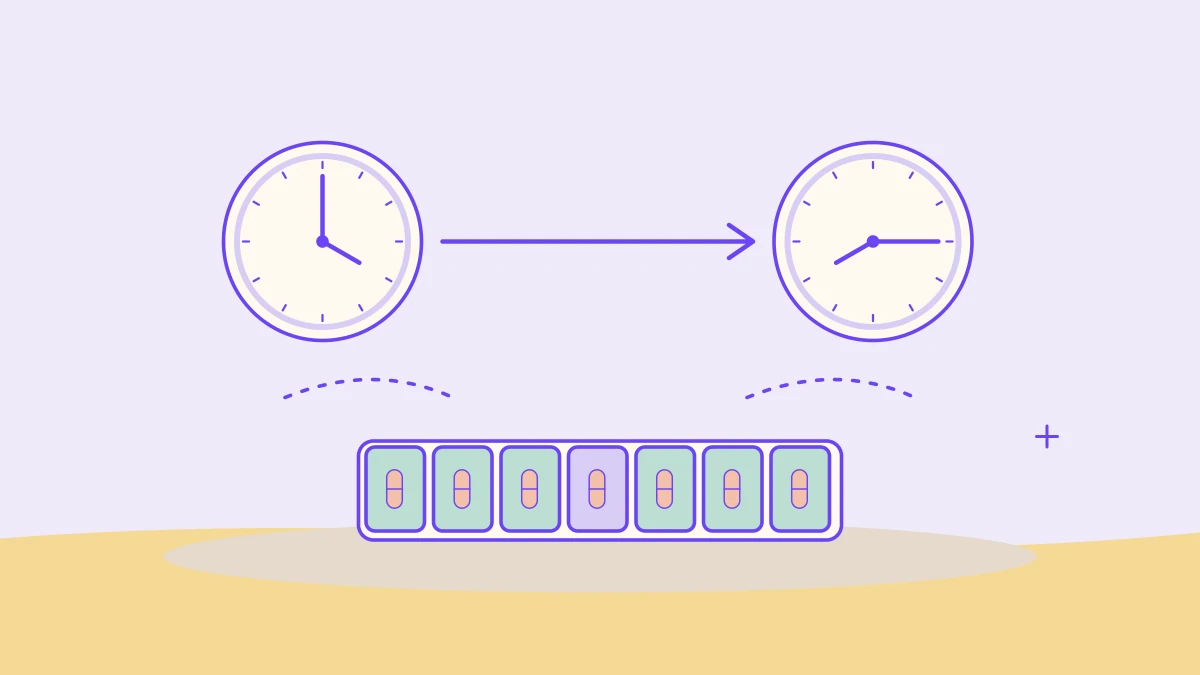
Imagine travelling from a place using UTC+1 to a place using UTC+7: the destination is six hours ahead. Monday 20:00 at the departure point and Tuesday 02:00 at the destination describe the same moment. Recording both prevents a date change from looking like a missed or extra dose.
If a once-daily dose were taken on Monday at 20:00 UTC+1 and the next on Tuesday at 20:00 UTC+7, the elapsed time would be 18 hours. Reversing those offsets would make that interval 30 hours. These are arithmetic examples, not recommended dosing intervals. Ask the pharmacist how your prescribed regimen should move to the new routine.
Sources: CDC Yellow Book: travellers with chronic illnesses ↗ · CDC: travelling abroad with medicine ↗
Give the pharmacist an itinerary they can use
A departure time alone is not enough for a journey with several connections. Bring the schedule for both directions and the medicine packaging, including any separate tablets that form the regimen. Explain which local routine will be practical during the stay.
- Write the last usual dose before departure with its date and time zone.
- List each departure, arrival and overnight stop using the time zone shown on the booking.
- Ask for the next agreed dose time at each transition and when to adopt the destination routine.
- Include meals, antacids, supplements and any other medicines with timing instructions.
- Obtain a contact route for delays or a missed dose, and save the plan offline.
Sources: CDC Yellow Book: travellers with chronic illnesses ↗ · NIH: following an HIV treatment regimen ↗
Check what your reminder does after landing
A reminder set for 20:00 may follow the phone’s new local clock. Check the app’s time-zone behaviour before departure; do not assume that a recurring alarm preserves the agreed interval. Label the reminder with the medicine and the planned city or time zone.
Record a dose when it is taken, not when the reminder appears. Keep the actual date and location in the record during a flight that crosses midnight. If a companion helps, use the same record so that two reminders do not lead to two doses.
Sources: NIH: following an HIV treatment regimen ↗ · CDC Yellow Book: travellers with chronic illnesses ↗
If a dose is late, use that medicine’s instructions
The UK Biktarvy 50/200/25 mg leaflet measures lateness from the usual dose time. The UK Dovato 50/300 mg leaflet instead refers to the time remaining before the next dose. Their rules illustrate why a single “hours late” formula cannot cover every HIV tablet.
Use the current instructions for your own product and the agreed travel schedule. If you cannot tell when the dose was due, give a pharmacist the actual last-dose time and both time zones. Do not take a double dose to compensate. A missed injection appointment requires advice from the administering clinic.
Sources: Gilead: UK Biktarvy 50/200/25 mg patient leaflet ↗ · ViiV: UK Dovato 50/300 mg patient leaflet ↗ · NIH: following an HIV treatment regimen ↗
Fit meals and other products into the same plan
A flight meal, a mineral supplement and a heartburn remedy can all affect how practical a dosing plan is. Biktarvy and Dovato have product-specific instructions involving antacids or mineral supplements; food can change some of those instructions.
Ask the pharmacist to write the complete sequence, including any required food or separation, rather than checking each tablet in isolation. Do not borrow the timing advice for another person’s HIV medicine.
Sources: Gilead: UK Biktarvy 50/200/25 mg patient leaflet ↗ · ViiV: UK Dovato 50/300 mg patient leaflet ↗
Keep the planned dose accessible
Carry the medicine in its labelled original packaging in hand luggage. Before a cabin suitcase is checked at the gate, remove the medication pouch. A well-written schedule cannot prevent a gap if the next tablet is in an inaccessible checked bag.
Arrange enough permitted supply for the trip and possible delays, while checking import limits along the route. Follow the storage instructions for the actual pack during connections and ground transfers.
Sources: CDC: travelling abroad with medicine ↗ · NIH: travelling safely with HIV ↗
Use the plan again for delays and the return journey
When a flight changes, preserve the record of doses actually taken. Send the revised itinerary and that record to the pharmacist if the original schedule no longer works. Do not restart the timetable simply because an airline changes the arrival date.
Plan the return transition before leaving home, including the first working day back and the next refill. If a gap has already occurred or you cannot keep tablets down, contact the HIV team for an assessment rather than trying to repair the schedule with extra doses.
Sources: CDC Yellow Book: travellers with chronic illnesses ↗ · NIH: following an HIV treatment regimen ↗
Common questions
Can I just take it at the same local time everywhere?
Ask your pharmacist first. The same clock reading can produce a shorter or longer interval after a time-zone change. The suitable transition depends on the prescribed regimen.
Sources: CDC Yellow Book: travellers with chronic illnesses ↗ · CDC: travelling abroad with medicine ↗
Does crossing midnight mean I need another tablet?
No extra dose is created by a date change. Follow the agreed schedule and record when a dose was actually taken; the calendar date alone cannot establish whether another is due.
Sources: CDC Yellow Book: travellers with chronic illnesses ↗ · NIH: following an HIV treatment regimen ↗
Can I use the Biktarvy missed-dose window to plan a long flight?
An accidental missed-dose instruction is not a recommended time-zone adjustment. Ask for a travel schedule and keep the product leaflet for an unexpected late dose.
Sources: Gilead: UK Biktarvy 50/200/25 mg patient leaflet ↗ · CDC Yellow Book: travellers with chronic illnesses ↗